Cara Menentukan Ukuran IBC Tank yang Tepat
Learn how to choose the right IBC tank size based on working volume, material density, headspace, dimensions, handling, and industrial application

Choosing the right IBC tank size is important for safe storage, efficient handling, and smooth production operations. An IBC tank that is too small may require frequent refilling, while an oversized tank can take up unnecessary space and increase handling costs.
But how do you know which IBC tank size is right for your application?
This guide explains the most important factors to consider when selecting an IBC tank size for industrial liquids, chemicals, food ingredients, and other materials.
What Is an IBC Tank?
An IBC (Intermediate Bulk Container) is a reusable container designed for storing and transporting liquids, powders, and other bulk materials.
IBC tanks are commonly used in industries such as:
Chemical
Paint and coating
Adhesive
Food and beverage
Pharmaceutical
Agriculture
Cosmetics
Lubricants
Water treatment
The most common industrial IBC tank capacities are around 500 liters, 1,000 liters, and 1,250 liters, although the appropriate size depends on the application and tank design.
How Do You Know What IBC Tank Size You Need?
There are several factors to consider when selecting an IBC tank size.
1. Determine the Required Working Volume
The first step is to determine how much material you need to store.
For example, if your production process normally handles 800 liters of liquid at one time, a 1,000-liter IBC may be more practical than a 500-liter tank.
However, the tank should not normally be filled completely to its nominal capacity. You need to consider free space or headspace for safe handling and, depending on the material, thermal expansion.
For example:
Required material volume: 800 L
IBC nominal capacity: 1,000 L
This provides additional space above the working volume.
2. Check the Density of the Material
Tank capacity is usually specified in liters, but the weight of the material depends on its density.
The basic calculation is:
Weight (kg) = Volume (L) × Density (kg/L)
For example, if you need to store 1,000 liters of a liquid with a density of 1.2 kg/L:
1,000 L × 1.2 kg/L = 1,200 kg
This means the contents alone weigh approximately 1,200 kg.
This calculation is important because the tank, frame, forklift, pallet, and floor must be capable of handling the total load.
3. Consider the Available Space
The physical dimensions of the IBC are just as important as its capacity.
Before choosing a tank, measure:
Available floor area
Door width and height
Ceiling height
Storage rack dimensions
Forklift access
Loading and unloading area
Distance between tanks
A 1,000-liter IBC may be a suitable volume, but it may not be suitable if the storage area or access route is too narrow.
4. Check Your Handling Equipment
How the IBC will be moved is another important consideration.
Ask:
Will it be moved by forklift?
Will it be lifted by crane?
Will it be transported by pallet truck?
Does the production area have sufficient access?
What is the forklift's maximum lifting capacity?
For heavier liquids, the gross weight of the filled IBC can become significant.
For example, a 1,000-liter IBC containing a liquid with a density of 1.5 kg/L would contain approximately:
1,000 × 1.5 = 1,500 kg
The total handling weight will be higher after adding the weight of the IBC itself.
5. Consider the Type of Material
Not every material can be stored in a standard IBC.
The material may determine:
Tank material
Tank thickness
Valve type
Gasket material
Surface finish
Cleaning requirements
Temperature resistance
Chemical compatibility
For example, stainless steel IBC tanks are often selected for applications requiring greater durability, corrosion resistance, hygiene, or repeated use.
For aggressive chemicals, the compatibility between the stored material and the tank material must be checked carefully.
6. Consider Your Production Batch Size
Your production batch size is often one of the easiest ways to determine IBC capacity.
For example:
| Production Batch | Possible IBC Size |
|---|---|
| 200–400 L | 500 L |
| 500–800 L | 1,000 L |
| 800–1,000 L | 1,000–1,250 L |
| 1,000 L+ | Consider larger or multiple IBCs |
These are general guidelines. The actual tank size should be determined based on the material, filling level, equipment, handling method, and applicable requirements.
7. Decide Whether You Need a Standard or Custom IBC
Standard IBC dimensions are convenient because they are designed for common handling and transportation systems.
However, some industrial applications require a custom IBC tank.
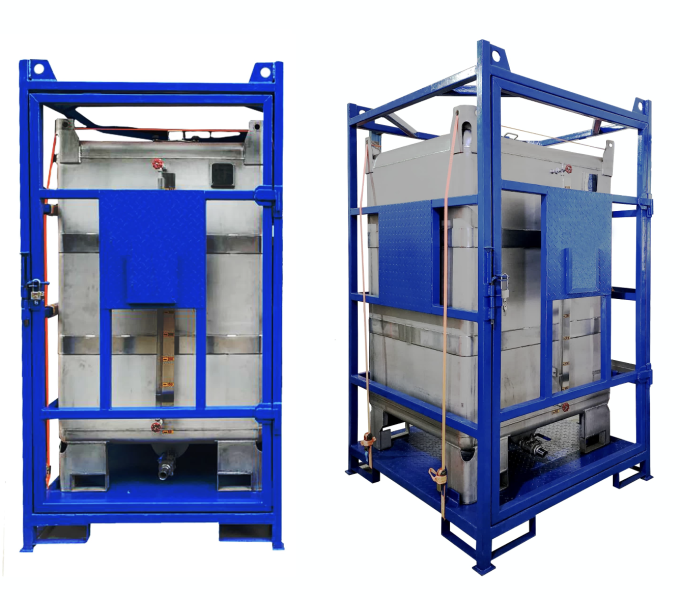
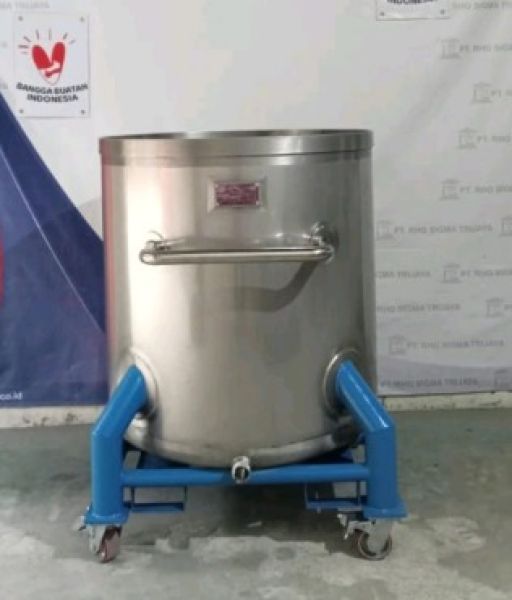
A custom stainless steel IBC may be designed with features such as:
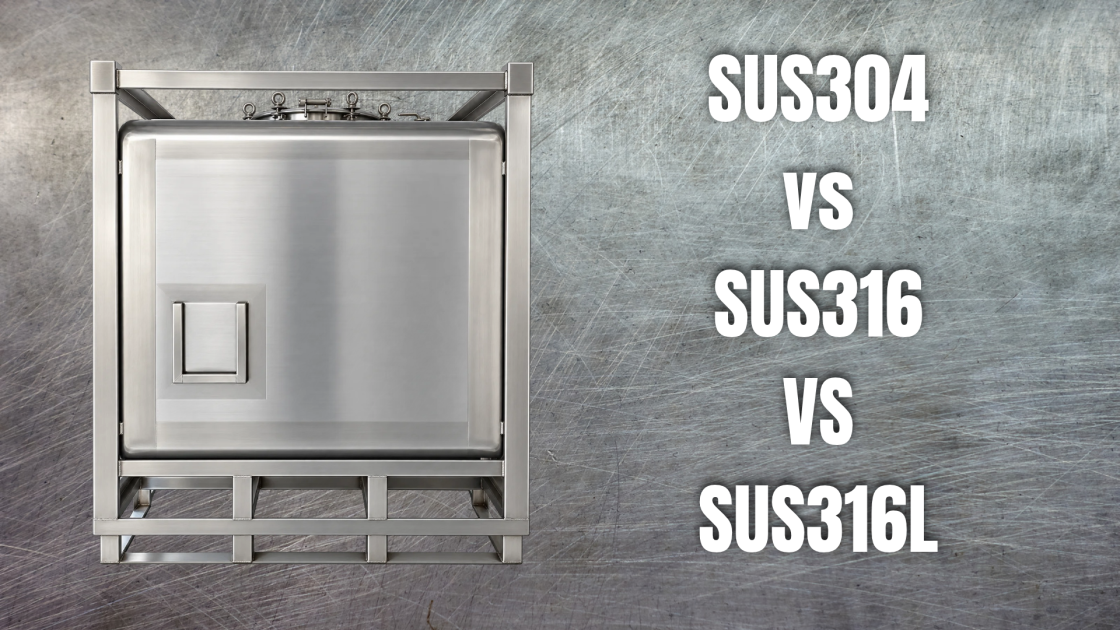
SUS304 or SUS316L construction
Customized dimensions
Special outlet configuration
Bottom discharge
Top manhole
Agitator
Heating or cooling jacket
Insulation
Load cells
Special valves
Customized lifting frame
Higher-pressure requirements where applicable
Custom design can be useful when the IBC needs to integrate directly with a production process rather than simply being used for storage and transportation.
Common IBC Tank Capacities
The appropriate IBC size depends on the application, but several capacities are commonly used in industry.
500-Liter IBC
A 500-liter IBC can be suitable when:
Production batches are relatively small
Floor space is limited
Manual or smaller-scale handling is required
The material is relatively heavy
Frequent material movement is required
1,000-Liter IBC
The 1,000-liter IBC is one of the most common choices for industrial applications.
It provides a useful balance between:
Storage capacity
Handling
Transportation
Floor space
Production batch size
It is commonly used for chemicals, ingredients, liquid raw materials, and intermediate production storage.
1,250-Liter IBC
A 1,250-liter IBC can provide additional capacity when a 1,000-liter tank is not sufficient.
However, increasing capacity also means considering the additional weight and physical dimensions.
Don't Choose an IBC Based on Liters Alone
One common mistake is choosing an IBC based only on its nominal capacity.
For example:
“I need 1,000 liters, so I will buy a 1,000-liter IBC.”
This may not always be the correct approach.
You should also consider:
Material volume + density + headspace + tank dimensions + handling equipment + material compatibility + production requirements
A correct IBC selection should consider the entire operating environment.
Simple IBC Size Selection Formula
A simple starting point is:
IBC Nominal Capacity ≥ Required Working Volume ÷ Target Fill Ratio
For example, if you need to store 800 liters and your target fill ratio is 80%:
800 ÷ 0.80 = 1,000 liters
Therefore, a 1,000-liter IBC would be a logical starting point.
The actual allowable fill level depends on the tank design, material, temperature, transportation requirements, and applicable standards.
Questions to Ask Before Ordering an IBC Tank
Before purchasing or manufacturing an IBC tank, prepare the following information:
What is the required working volume?
What is the material being stored?
What is its density?
What is its viscosity?
Is the material corrosive?
What temperature will the material have?
How will the IBC be filled?
How will it be discharged?
Will the material require agitation?
Will the tank be heated or cooled?
How will the tank be transported?
What are the available storage dimensions?
What is the maximum allowable total weight?
Does the application require SUS304 or SUS316L?
Does the tank need to be customized?
Final Thoughts
Knowing your IBC tank size is not simply a matter of choosing between 500 L, 1,000 L, or 1,250 L.
The correct size should be based on your working volume, material density, available space, handling equipment, production batch size, and application requirements.
For standard storage and transportation, a standard IBC may be sufficient. However, industrial processes that require special discharge systems, agitation, heating, cooling, or specific dimensions may benefit from a custom stainless steel IBC tank.
If you are unsure which IBC tank size is suitable for your application, start by determining your required working volume and material density. From there, the appropriate tank capacity and configuration can be evaluated.
Need a custom stainless steel IBC tank?
PT Rho Sigma Trijaya manufactures custom stainless steel tanks and IBC tanks for industrial applications, with configurations designed according to capacity, material, process requirements, and handling system.